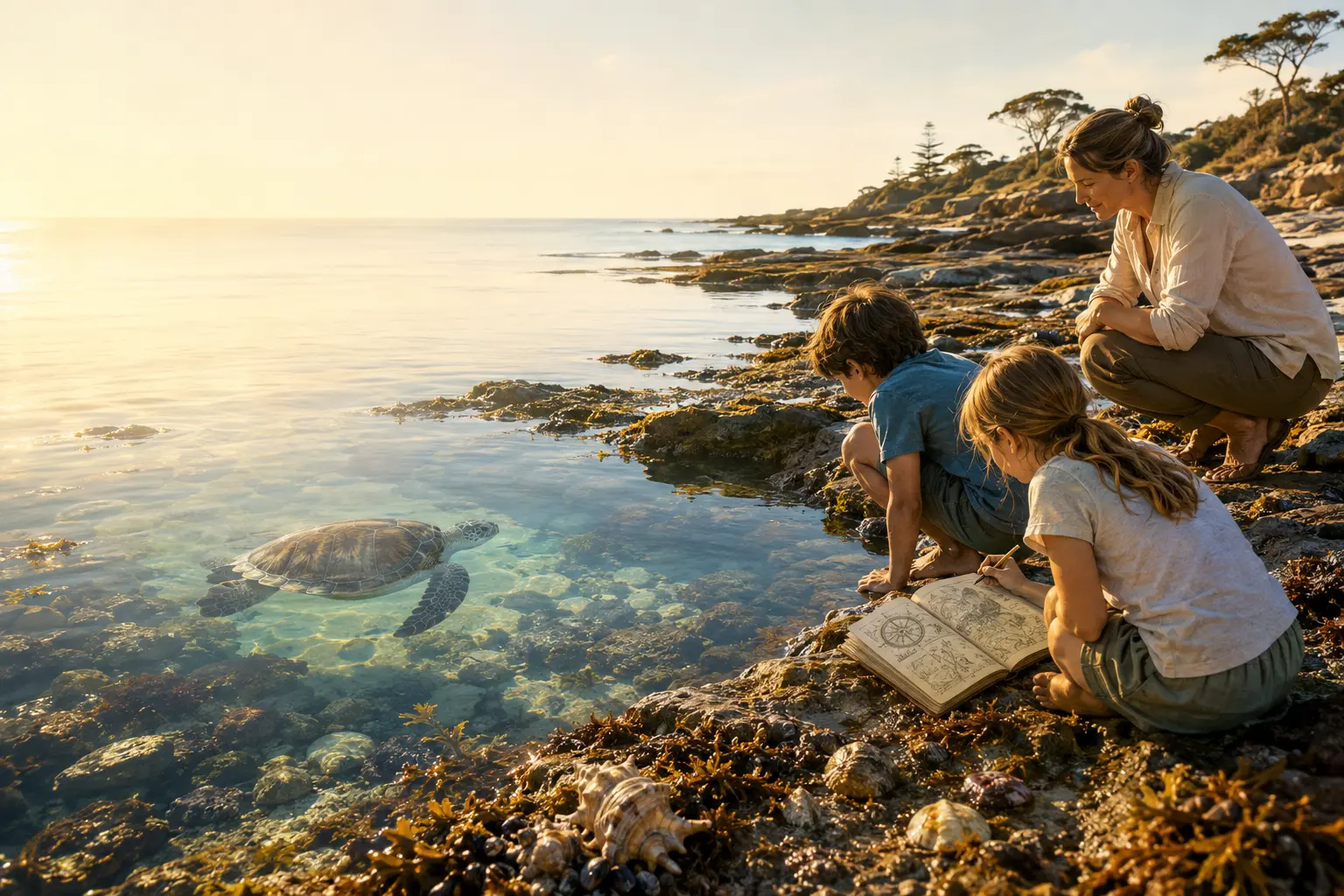
You do not need a perfect beach day—or even a nearby beach—to help a child investigate the ocean. Give them one clear objective, a safe way to collect evidence and a question worth bringing home.
Rock-Pool Census
Best at low tide · Observe onlySelect one rock pool and count the different kinds of living things you can see without touching or moving them.
- Look for snails, crabs, small fish, seaweed and anemones.
- Record shapes and colours when you do not know a species name.
- Repeat at a second pool and compare the results.
Why it matters: children discover that even a tiny pool can hold a whole community.
Tide-Line Detective
Beach investigation · 15 minutesWalk parallel to the water along the natural line of shells, seaweed and other material left by the last high tide.
- Find three natural objects and describe where they may have come from.
- Count human-made items without collecting anything unsafe.
- Predict where tomorrow’s tide line might appear.
Why it matters: the tide line reveals how water moves both natural material and litter.
Shorebird Behaviour Watch
Quiet observation · Keep your distanceChoose one shorebird and watch for five minutes. The mission is to record what it does rather than identify its species.
- Tally pecking, running, flying, resting and calling.
- Notice whether waves or people change its behaviour.
- Sketch its beak and feet and consider how each might help it feed.
Why it matters: patient watching develops respect for wildlife and reveals adaptations in action.
Ocean Sound Map
Sit spot · Paper and pencil optionalSit safely above the waterline. Imagine a dot in the middle of a page represents you, then place each sound around it.
- Use words, symbols or finger directions.
- Separate natural sounds from human-made sounds.
- Choose the quietest sound you could hear.
Why it matters: careful listening slows the experience down and strengthens awareness of place.
Wave Pattern Mission
Dry observation point · No water entryFrom a safe dry position, count how many waves reach the shore in one minute.
- Repeat three times and compare the totals.
- Notice whether waves arrive alone or in groups.
- Look for the point where each wave begins to curl or break.
Why it matters: repeated observations introduce data collection without turning the outing into a lesson.
One-Metre Beach Survey
Choose a safe square · Leave it unchangedMark an imaginary square about one metre wide on dry sand and investigate everything visible inside it.
- Count shells, plant pieces, animal tracks and human-made items.
- Look closely for holes, trails and patterns.
- Compare a square near vegetation with one closer to the tide line.
Why it matters: limiting the search area helps children notice details they would normally walk past.
Saltwater Float Test
At home · Bowl, water, salt and small objectsPredict whether the same object will float differently in fresh water and salty water.
- Mix several spoonfuls of salt into one bowl and keep a second bowl fresh.
- Test a grape, small carrot piece or tightly closed plastic building block.
- Add salt gradually and record when the result changes.
Why it matters: dissolved salt increases water density, helping some objects float more easily.
Make a Model Current
At home · Clear dish and food colouringFill a clear shallow dish with water. Place one drop of colouring at one end and move the water gently with a spoon at the other.
- Watch the coloured water travel.
- Try a slow circular movement, then one straight movement.
- Predict where a floating leaf fragment would go.
Why it matters: a simple model shows how moving water can carry heat, nutrients and pollution.
Ocean Plastic Source Hunt
Home investigation · No beach requiredChoose five common plastic items in your home and investigate which ones could escape into drains, streets or waterways.
- Look for single-use packaging and tiny loose pieces.
- Choose one item the household could reuse, replace or secure better.
- Make the change for one week and report back.
Why it matters: ocean protection often begins far from the ocean.
Sea Turtle Navigation Challenge
Backyard or park · Movement missionChoose a start point as the “feeding ground” and a finish point as the “nesting beach.” One person secretly places three safe obstacles between them.
- The migrating turtle must find a route without touching an obstacle.
- Try again with a partner giving only compass directions.
- Discuss why real turtles need safe migration routes and dark nesting beaches.
Why it matters: movement makes migration challenges easier to imagine and remember.
Design a Wildlife-Safe Beach Sign
Creative field file · Paper and drawing toolsCreate one clear sign that helps visitors protect a shore animal or habitat.
- Choose one action: give birds space, take litter home or keep lights low.
- Use one strong image and no more than eight words.
- Test whether another person understands it in five seconds.
Why it matters: designing for a real audience turns knowledge into useful communication.
Family Ocean Action File
Positive action · One weekChoose one realistic household action that protects waterways and track it for seven days.
- Try a reusable lunch item, a litter-free outing or careful drain disposal.
- Make one tally mark each time the family completes the action.
- At the end, decide whether to keep, change or replace the mission.
Why it matters: small repeated actions build agency without frightening or blaming children.